
SOC Metrics and Objectives
SOC Metrics and Objectives
Assets & Metrics
SOC Goal: Protect confidentiality, integrity, and availability of digital assets by developing, receiving, and triaging alerts.
L1 Role: Report True Positives to L2 for remediation.
Alerts Count:
- Measures unresolved alerts in queue.
- Too many (e.g., 80/day): Overwhelming, risks missing threats.
- Too few (e.g., 0/week): Indicates SIEM issues or lack of visibility.
- Ideal: 5–30 alerts/day per L1 analyst.
False Positive Rate:
- Percentage of alerts confirmed as noise (e.g., 94% = 75/80 False Positives).
- High rate (80%+): Reduces vigilance, requires tool/detection rule tuning (False Positive Remediation).
- Ideal: Below 80%, 0% unachievable.
Alert Escalation Rate:
- Percentage of alerts escalated to L2.
- Reflects L1 experience/independence.
- Ideal: Below 50%, preferably below 20%.
Threat Detection Rate (TDR):
- Percentage of attacks detected/prevented (e.g., 4/6 attacks = 67%).
- Goal: 100% (every missed threat risks severe impact, e.g., ransomware, data exfiltration).
Triage Metrics
Ensure timely detection, triage, and response to threats.
Service Level Agreement (SLA):
- Contract between SOC and management (or MSSP and clients).
- Defines response timelines.
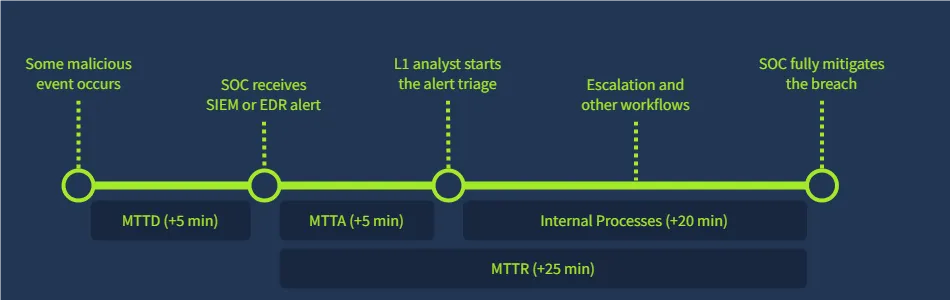
Mean Time to Detect (MTTD):
Time from attack start to alert generation (e.g., 12 min for malware C2 connection).
Mean Time to Acknowledge (MTTA):
Time from alert to L1 moving it to “In Progress” (e.g., 10 min).
Mean Time to Respond (MTTR):
Total time from alert to remediation (e.g., 51 min: 10 min MTTA + 6 min to escalate + 35 min L2 cleanup).
Improving Metrics
Importance for L1:
- Enhances SOC efficiency, reduces attack success.
- Used to evaluate performance, impacts career growth (e.g., promotion to L2).
Improvement Strategies:
- Alerts Count: Tune SIEM rules to balance visibility and noise.
- False Positive Rate: Adjust detection rules to reduce noise.
- Escalation Rate: Build experience to handle more alerts independently.
- Threat Detection Rate: Improve detection rules, ensure proper triage.
- Triage Metrics (MTTD/MTTA/MTTR): Act quickly, follow workflows, escalate efficiently.