SOC Workbooks and Lookups
SOC Workbooks and Lookups
Assets & Identities
Use inventories to determine if activity (e.g., file sharing) is expected or suspicious.
Identity Inventory:
- Catalogue of employees (user accounts), services (machine accounts), and details (privileges, contacts, roles).
- Helps understand user context (e.g., roles, working hours of G.Baker, R.Lund).
Asset Inventory:
- List of computing resources (servers, workstations) in the IT environment.
- Provides context on assets (e.g., purpose, location of HQ-FINFS-02).
Network Diagrams
Network Diagrams:
- Visual schema of locations, subnets, and connections.
- Helps analyze network activity (e.g., services on ports, subnet roles).
Attack Path Reconstruction:
- Threat actor (103.61.240.174) performs VPN brute force on TCP/10443.
- Gains VPN access, assigned IP (10.10.0.53) in VPN Subnet.
- Scans Database Subnet (172.16.15.0/24), blocked by firewall.
- Switches to Office Subnet (172.16.23.0/24) for further targets.
Workbooks Theory
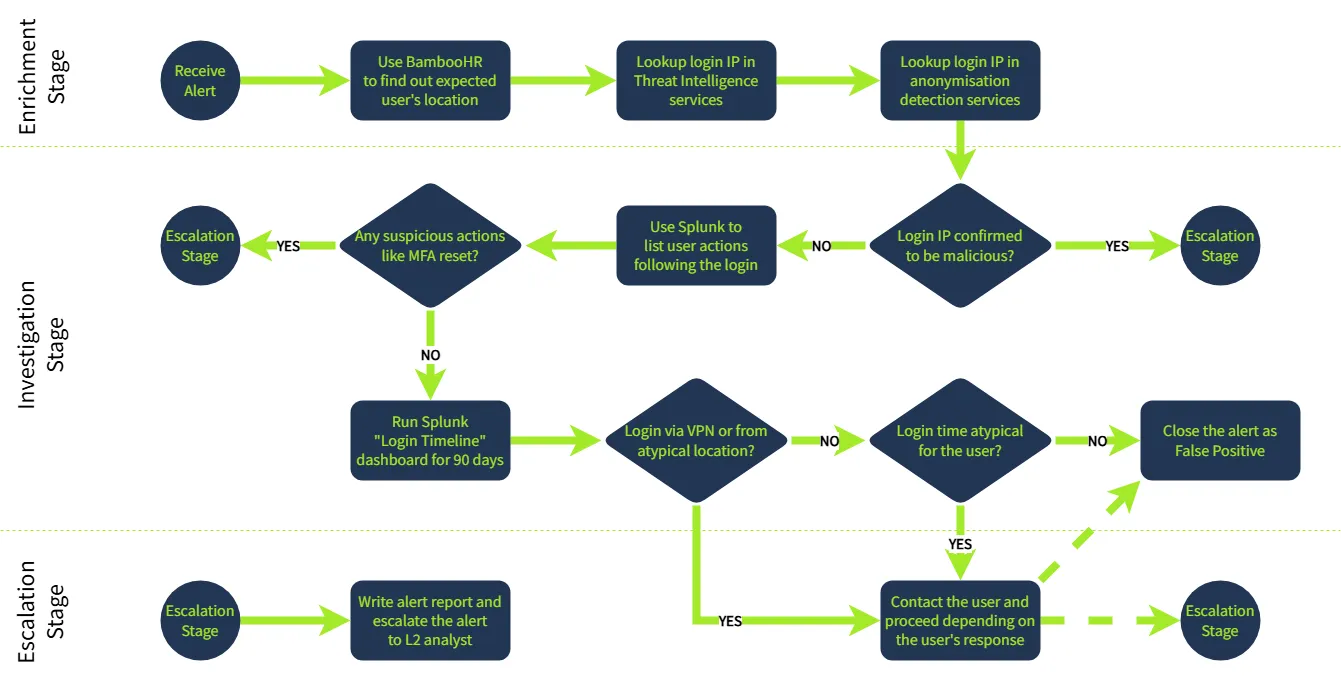
Ensures L1 follows all steps, preventing missed evidence or incorrect verdicts. Streamlines analysis for junior analysts.
SOC Workbooks:
- Structured documents (aka playbooks/runbooks/workflows) defining steps to investigate/remediate threats consistently.
- Created by senior analysts to support L1 analysts in avoiding mistakes.
Workbook Structure (e.g., Atypical Login Alerts):
- Enrichment: Gather context using Threat Intelligence, identity inventory.
- Investigation: Analyze data, SIEM logs to determine if activity is expected.
- Escalation: Escalate to L2 or communicate with user if needed.